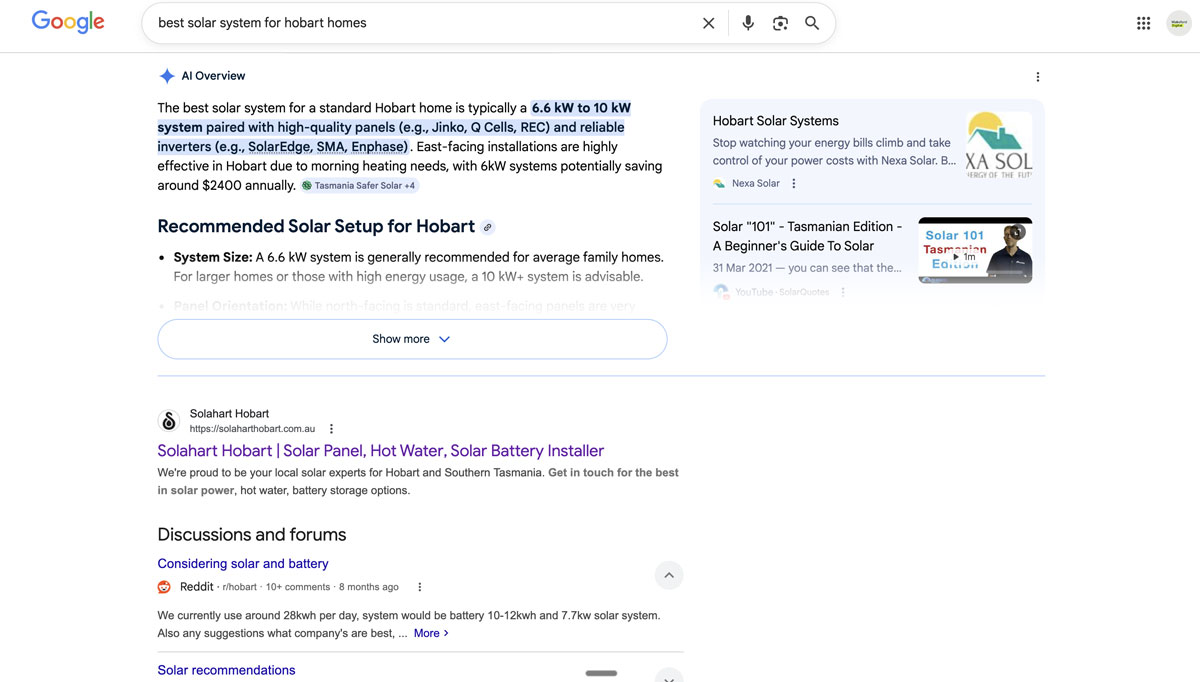
If you've been Googling something lately, maybe "best electrician near me" or "web designer in Hobart", you've probably noticed something, well... a little different about the results.
Before you even get to the familiar blue links, there's a big AI-generated summary sitting right at the top of the page, pulling information from various websites and packaging it into a neat little answer.
That's Google's AI Overview. And it's just one of many ways AI is changing how people find businesses online.
Between ChatGPT, Google's AI Overviews, Perplexity, and Microsoft Copilot, more and more of your potential customers are getting their answers from AI, not by clicking through to your website.
So the question is: is your website set up so these AI tools can actually find, understand, and recommend your business?
For most small businesses across Tasmania, the honest answer is probably "not yet." But the good news is, it's not too late, and a lot of the things that make your website AI-friendly are things you should be doing anyway.
Dominic, owner of Wakeford Digital, shares: "There's a genuine interest from our clients when it comes to both AI search and using AI for their digital marketing efforts."
"I'd say the majority are aware of it, but probably just not how vast the shift has been or how important it is to consider all facets when it comes to getting found online."
"The businesses that get onto this early, even in a smaller market like Hobart, are going to have a real advantage."
Let's start with the basics.
AI search is the broad term for how artificial intelligence tools (think ChatGPT, Google's AI Overviews, Perplexity, and Microsoft Copilot) find, process, and present information to users.
Instead of showing you a list of ten links and letting you pick, AI search tools read through multiple websites and generate a direct answer, often citing the sources they pulled from.
Here's why that matters: if your website isn't structured in a way that AI can easily understand and trust, you won't get cited in those answers. And increasingly, those AI-generated answers are where your customers are looking first.
The numbers back this up. As of late 2025, around 60% of Google search results pages feature an AI Overview (Source: Advanced Web Ranking).
AI referral traffic to websites surged 527% year-over-year in the first five months of 2025 (Source: Search Engine Land / Previsible). And here's the kicker: visitors arriving from AI platforms convert at rates 4-5 times higher than traditional Google visitors (Source: Semrush), because they've typically already done their research through the AI conversation and arrive with stronger purchase intent.
For a small business in Hobart, Kingston, or Launceston, this isn't just a theoretical trend but it's a real shift in how your next customer might find you.
Before you start making changes, it helps to know where you stand.
Here are the key areas to assess if your website is AI-ready:
AI tools don't read your website the way a human does. They scan it, break it down into chunks, and evaluate each piece for relevance, authority, and clarity.
That means your content needs to be well-organised with clear headings (H1, H2, H3), written in plain language, and thorough enough to actually answer the questions your customers are asking.
Ask yourself: if someone asked ChatGPT a question about your industry or service area, would your website content provide a clear, complete answer? Or would it be vague, salesy, and thin on detail?
Dom's Tip: "Having more detailed content is always about a careful balance of not just overloading and writing content for the sake of it. But we definitely see noticeable differences when clients have more detailed services content and individual pages. Hobart Builder Nomac Built are a great example of this, where their bathroom renovations page ranks really well alongside their home page too."
Google has been clear about this as well.
Their own guidance on helpful content encourages businesses to focus on creating unique, non-commodity content that genuinely helps visitors.
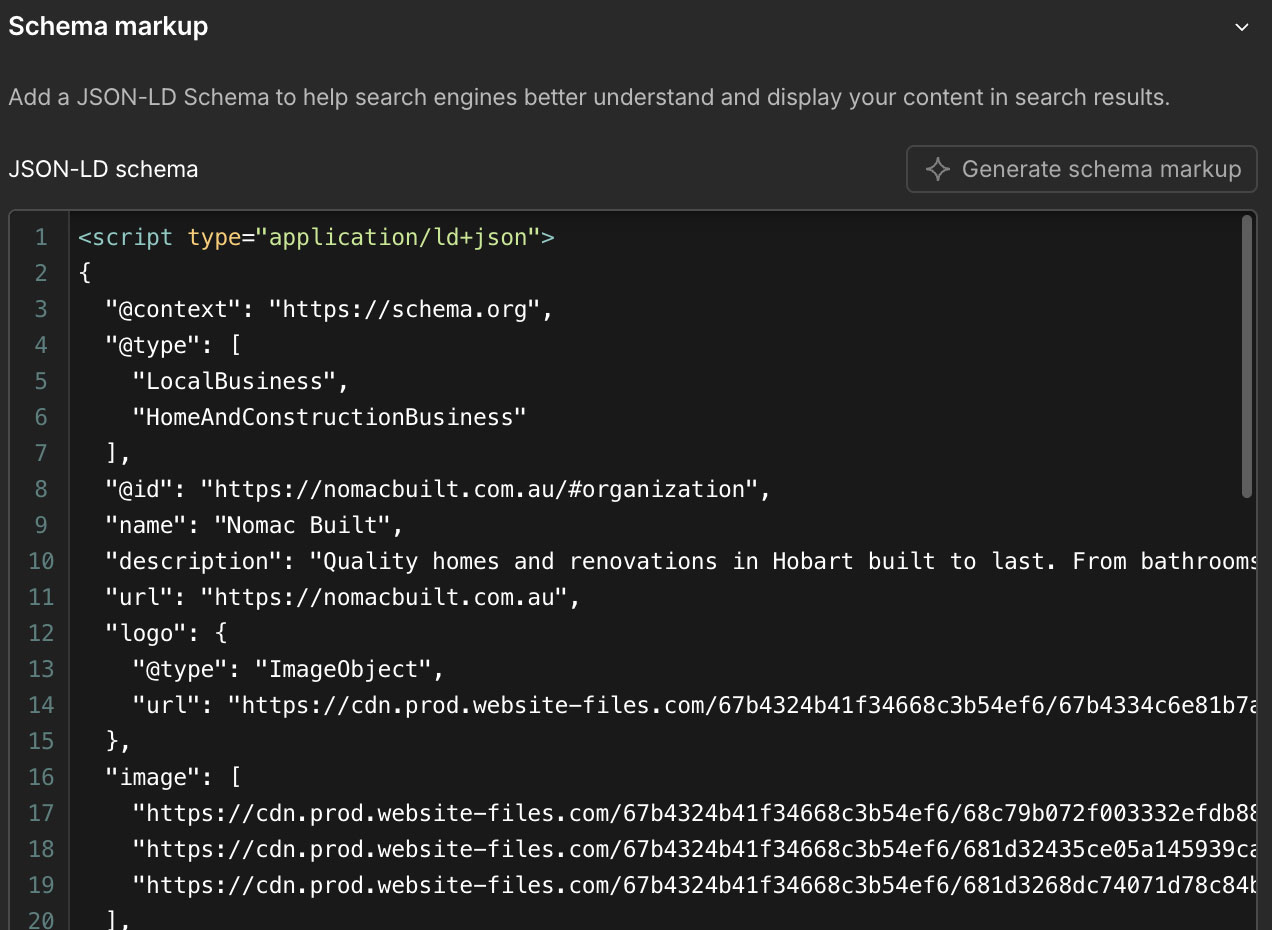
This is a big one, and it's where a lot of small business websites fall short. Schema markup is code that sits behind the scenes on your website and tells search engines (and AI tools) exactly what your content is about: your business name, location, services, opening hours, reviews, FAQs, and more.
Think of it like labelling the contents of your pantry. Without labels, someone unfamiliar with your kitchen would have to open every container to figure out what's inside.
Schema markup is the label, except for your website, it says "this is a local business in Hobart that offers web design services."
Over 72% of websites appearing on Google's first page use some form of schema markup (Source: Backlinko).
For AI search specifically, structured data helps AI tools parse, validate, and trust your content, making it far more likely they'll cite your business.
The key types to prioritise include:
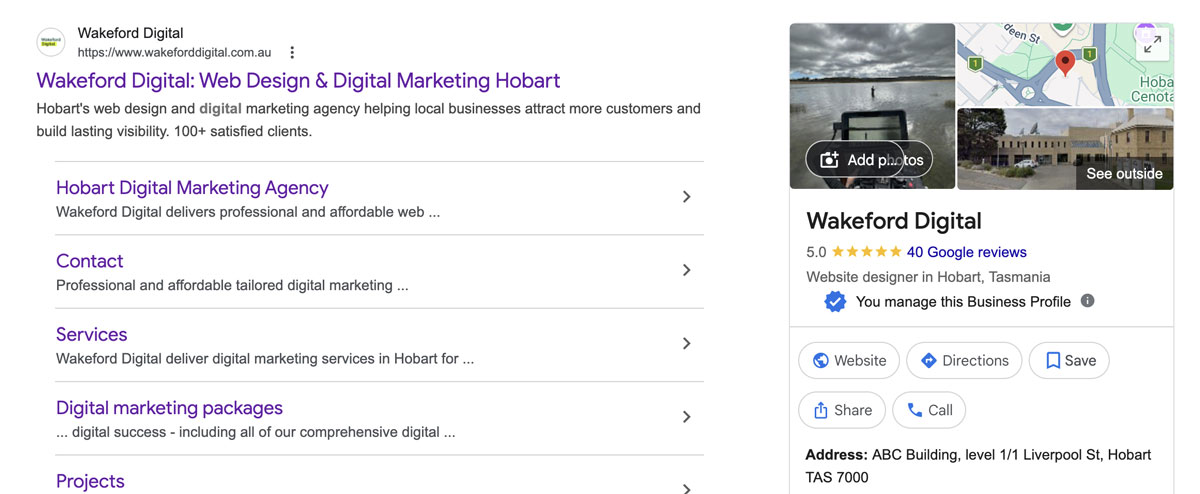
Your Google Business Profile (GBP) is one of the most important (and so often overlooked) data sources that AI tools reference when answering local queries.
If someone asks ChatGPT or Google's AI "Who's a good web designer in Hobart?", the AI is going to pull from sources it trusts, and a complete, well-maintained GBP is near the top of that list.
How do you optimise your Google Business Profile? Make sure your profile includes...
This isn't new advice, but it's become even more important in the age of AI search.
Dom's Tip: "A monthly review of your Google Business Profile is a good rhythm to get into, and it's definitely something we find businesses aren't doing."
"Updating photos, scheduling posts, and keeping information current can really help boost your profile. I think the most overlooked element is actually just doing it. It's such a small factor compared to something like Instagram, but it obviously contributes a lot to getting found via Google."
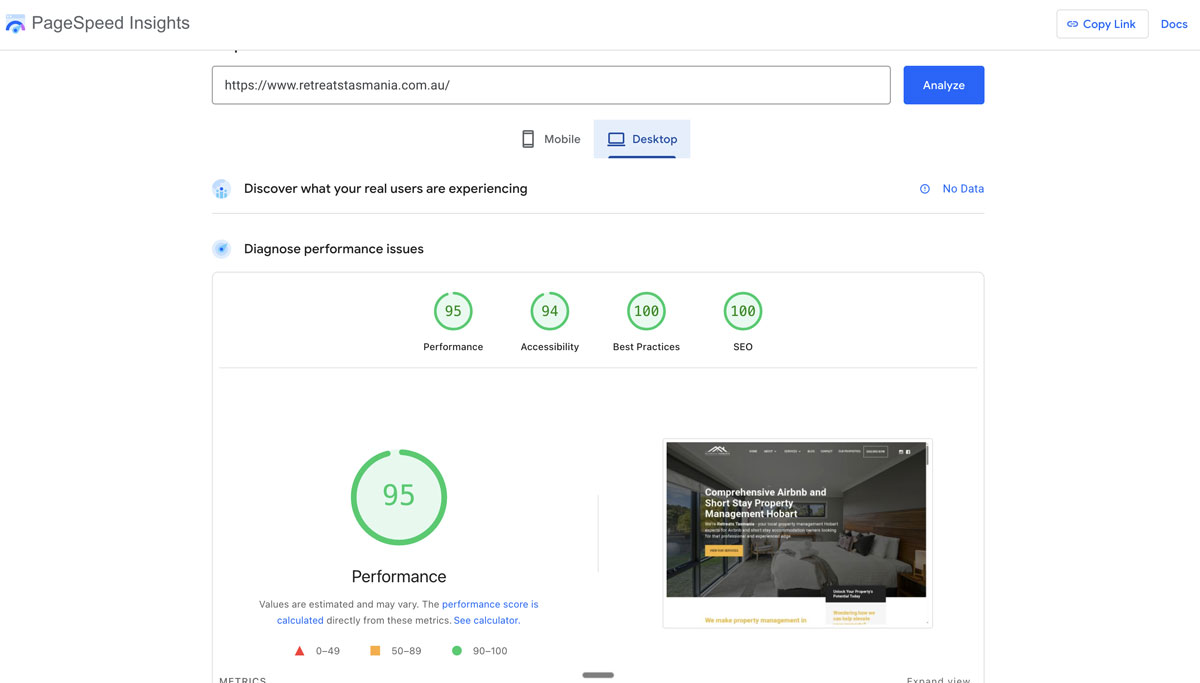
AI crawlers, just like traditional search engine bots, need to access and read your website without issues. The essentials include fast loading speeds, mobile-friendly design, clean and crawlable code, an SSL certificate (HTTPS), and a proper sitemap.
If your website is built on a solid platform like Webflow, many of these technical foundations are handled well out of the box. But it's still worth running a check, particularly if your site hasn't been updated in a while. Our post on common website mistakes covers some of the most frequent technical issues we see on Tasmanian business sites.
AI tools love content that directly answers questions (see the earlier screen grab that shows Reddit in the top results!).
They're built to find clear, authoritative, and well-sourced answers to the kinds of queries real people are typing in.
For a Hobart small business, this means blog posts that answer common customer questions in detail, FAQ sections on your key service pages, how-to guides and practical advice relevant to your industry, case studies showing real results for real clients, and location-specific content that ties your expertise to Tasmania.
The more helpful and specific your content, the more likely AI tools are to reference it. Generic, thin content that could apply to any business anywhere won't cut it.
Dominic notes, "We often speak about this omni-channel approach, and that is having a video that complements a blog post that links into a key page."
"Trout Tales Tasmania is a really good example of this, where we've seen some really fantastic AI search results based on just having a comprehensive, consistent, and multifaceted website."
This ties into the holistic digital marketing approach we've been writing about recently, where all of your digital channels work together rather than in isolation.
Right, so you've had a look at where things stand. Now, what do you actually do?
Here's a practical, prioritised checklist on how to get your website optimised for AI:
Before changing anything, take stock.
Run your website through Google's PageSpeed Insights for technical health. Check your Google Business Profile for completeness. Review your service pages: are they comprehensive, or are they just a few lines and a contact form?
If you'd like a hand with this, we offer a free website analysis and free SEO analysis for Tasmanian businesses. It's a great starting point.
We also published our findings from analysing 100 Tasmanian business websites, which might give you a sense of where common gaps tend to be.
If your website doesn't have schema markup, this should be your first priority.
At minimum, add LocalBusiness schema with your complete business details and Organisation schema for brand information. If you're running a blog, add Article or BlogPosting schema, and add FAQPage schema to any FAQ sections.
For businesses using Webflow, adding schema markup is straightforward and something we handle as part of our website and SEO builds.
Start with your most important service pages. Make sure each one has at least 500-800 words of genuinely helpful content that answers the questions your customers are asking.
You can use tools like Google Search Console to help identify these or your own website analytics or knowledge.
Then, develop a simple blog strategy focused on real customer queries.
Think "how to choose a [your service] in Hobart", "what does [your service] cost in Tasmania", or "signs you need [your service]". If you're not sure where to start with blogging, our post on why most small business blogs fail (and how to fix it) is a good place to begin.
Complete every section. Add new photos regularly. Respond to reviews, all of them, good and bad. Post updates at least monthly. Make sure your service categories, service area, and business description are accurate and detailed.
Our listings and reviews management service can help you stay on top of this if you're short on time, which, let's be honest, most small business owners are.
AI search is evolving quickly. What works today will need tweaking tomorrow.
Keep an eye on how your traffic sources are changing (are you starting to see referrals from ChatGPT or other AI tools?), and stay informed about how AI search features are rolling out in Australia.
The important thing is to start.
You don't need to do everything at once, but doing nothing means falling behind while your competitors (even the ones down the road in Glenorchy or out in the Huon Valley) quietly get ahead.
Do I need a completely new website to be AI-optimised?
Not at all. In most cases, AI optimisation is about improving what you already have: better content, proper schema markup, and a well-maintained Google Business Profile. If your current site is well-built and regularly updated, you're already partway there.
Is AI search actually relevant for small businesses in Tasmania?
Absolutely. While the overall volume of AI search traffic is still smaller than traditional Google traffic, it's growing at an extraordinary rate. And because fewer businesses in Tasmania are optimised for AI right now, there's a genuine first-mover advantage. The businesses that act now will be the ones AI tools learn to trust and cite.
Will AI search replace Google?
Not anytime soon. Google still handles over 90% of search traffic. But AI features are being built into Google (via AI Overviews), so optimising for AI and optimising for Google are increasingly the same thing. Good SEO and good AI optimisation go hand in hand.
How much does AI search optimisation cost?M
any of the most impactful steps, like updating your Google Business Profile, improving your content, and adding FAQ sections, cost nothing but time. For more technical work like schema markup implementation or a comprehensive SEO strategy, working with a digital marketing agency can help.
Check out our digital marketing services for options suited to different budgets.
How long before I see results?
AI visibility typically takes 3-6 months to build meaningful traction, similar to traditional SEO. The key is consistency: keep creating quality content, maintaining your profiles, and keeping your website technically healthy.
The way people search for information, and for businesses like yours, is changing.
AI-powered tools are already reshaping the search landscape, and for small businesses across Hobart and Tasmania, the opportunity is real and it's right now.
The fundamentals haven't changed: create helpful content, maintain a strong online presence, and keep your website in good shape. What's new is the importance of structuring your content and data so AI tools can understand and trust it.
Schema markup, comprehensive content, and a complete Google Business Profile aren't just "nice to haves" anymore. They're essential.
You don't need to become an AI expert overnight. Start with one step from the checklist above, build from there, and keep going. And if you'd like a hand figuring out where your website stands and what to focus on first, we're always happy to chat.
Get in touch to discuss your project, or take advantage of our free SEO analysis to see where the opportunities are.
Thanks for reading, and here's to making sure AI knows your business exists.