It's May 2026, and if you've been paying attention to your website traffic or scrolling through search results on your phone, you've probably noticed something shifting.
AI search results are everywhere now. ChatGPT, Claude, Perplexity, they're showing up at the top of Google, they're in your pocket via voice search, and they're quietly pulling traffic away from traditional organic rankings.
But here's the thing: most small business owners in Hobart haven't figured out yet whether this actually matters for them.
Is optimising for AI search a genuine priority, or is it just the latest digital marketing fad?
Let's dig into the actual numbers, because the answer might surprise you...
Dominic, owner of Wakeford Digital, shares: "It's certainly not a game changer in terms of throwing the baby out with the bath water with regards to AI - but from a trending point of view, the volume is definitely increasing."
"The ability to pick up your phone, particularly using voice and ask a question, is on the rise both overseas and on the ground with people using their devices."
"Our SEO platforms are also picking up on this, helping us gauge how well a website ranks in AI for specific search terms."
Let's start with the numbers, because the headlines and the reality don't always match up.
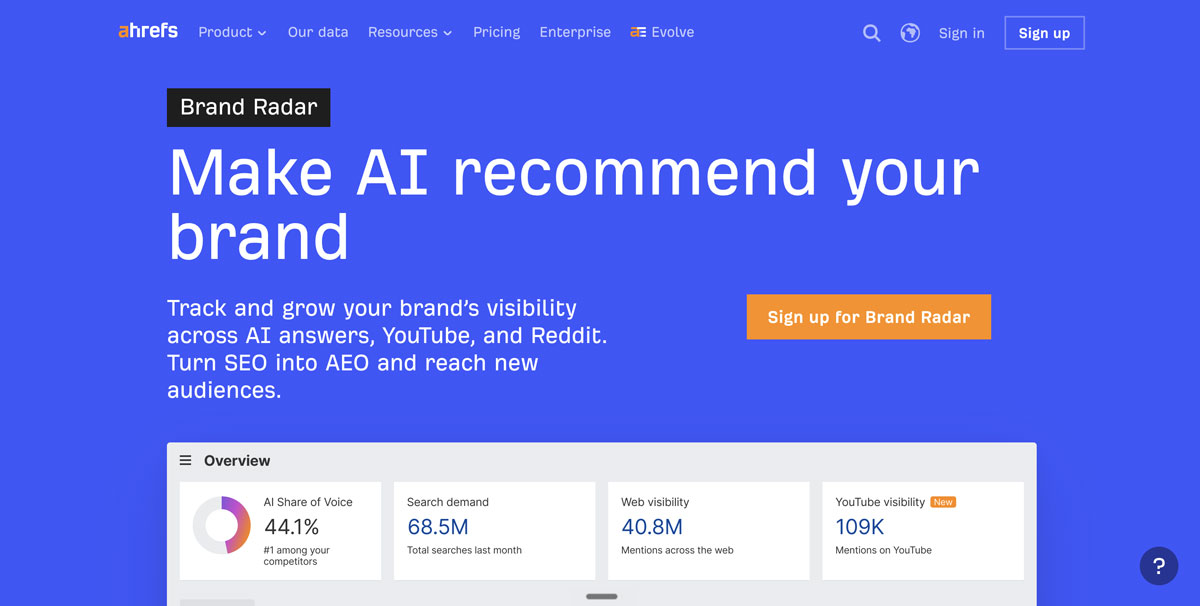
AI search referral traffic, that's traffic coming to your website from tools like ChatGPT, Claude, Perplexity, or Google's AI Overviews, currently sits at around 1% of total website traffic globally (Source: Conductor 2026 Benchmarks).
One percent. That's it.
So if you've been picturing a tidal wave of customers coming through ChatGPT, the truth is more modest, at least for now.
But here's where it gets interesting: the numbers tell a story when you look closer:
And the real kicker...
By the time someone clicks through from an AI tool, they've usually already had their question answered, considered their options, and are ready to take action.
So while the volume is small, the quality is high. For a small business in Hobart that doesn't need millions of visitors but does need genuine, ready-to-buy enquiries, that's a really compelling combination.
To bring this back down to earth, we pulled the numbers across 20 of our sampled Wakeford Digital clients over the last 90 days. Here's what we found.
The overall traffic breakdown across these clients looks roughly like this:
And within that AI Search slice, the platform breakdown looks like this:
Our clients sit in a specifically Tasmanian and largely local market, so the data reflects exactly what we'd expect for a Hobart-focused audience. The interesting thing is the pattern itself: every single client we analysed has measurable AI referrals coming through, even the ones who haven't done anything specific to optimise for it.
The other standout?
ChatGPT is dominating the AI search referral game, with more than half of all AI-driven visits across our client base coming from there. Gemini is a strong second, helped along by Google's AI Overviews appearing in search results.
The good news is that the things you do to rank well in one of these platforms tend to help across all of them.
Search isn't one single thing anymore, and that's the part that catches a lot of small business owners off guard. In 2026, when someone in Hobart goes looking for a plumber, a cafe, a web designer, or a tradie, what they see depends entirely on how they search.
Broadly, there are three areas worth understanding:
Let's break each one down...
This is the search you've known for years. Someone types a query into Google, and they get a list of websites ranked by relevance and authority. Traditional SEO, things like keyword optimisation, quality content, fast loading times, and backlinks, still drives this.
Despite all the AI hype, organic search remains the largest single source of search traffic for most websites, including ours.
That said, things are shifting. Google's AI Overviews now appear on roughly half of all tracked queries, a 58% increase year-over-year (Source: ALM Corp, 2026). When that happens, the old "race to position one" gets a bit more complicated, because the AI Overview sits above the blue links, often answering the question without the user clicking through at all.
Organic SEO still matters enormously. It's just no longer the whole picture.
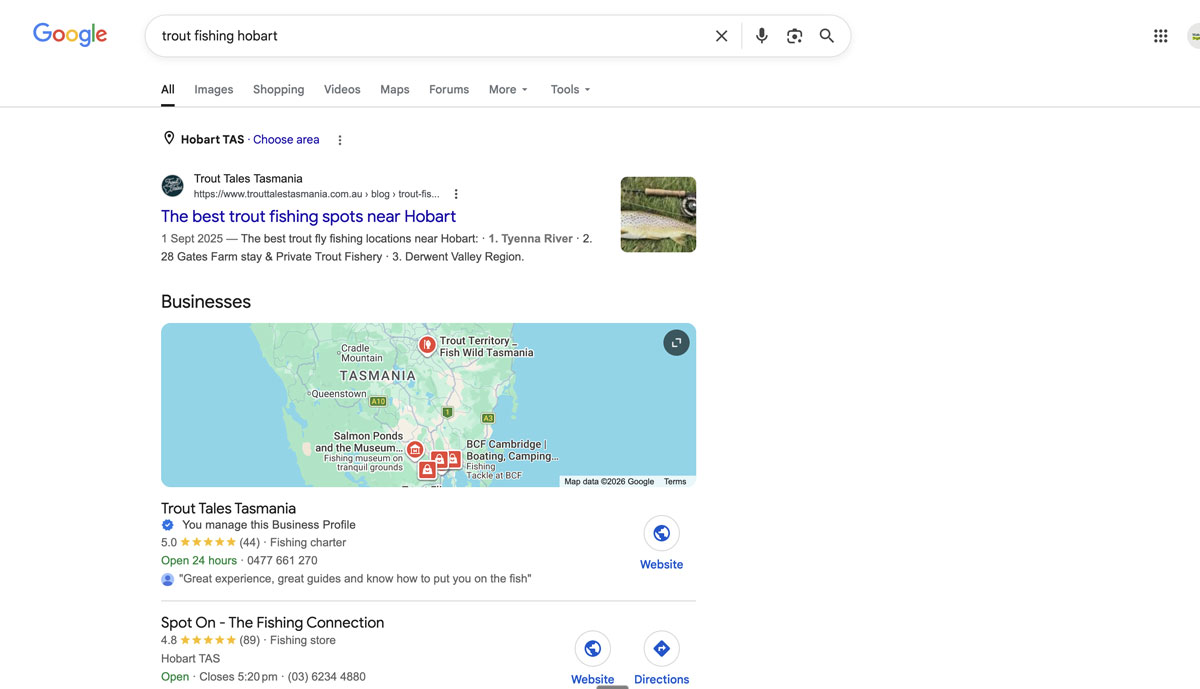
If you've got a physical location or service area in Hobart, the map pack is arguably the most important real estate online. It's that block of three local businesses with the map, ratings, and contact details that appears for searches like "cafe near me" or "electrician Glenorchy".
The map pack runs almost entirely on your Google Business Profile, your reviews, your local citations, and the relevance and proximity of your business to the searcher.
We've written before about local SEO and how to rank in the map pack, but the short version is this: for most local Hobart businesses, the map pack drives more enquiries than organic search ever will.
This is where intent really matters. If someone searches "licensed plumber in Hobart", they're not looking for an AI Overview to summarise plumbing. They're looking for a list of actual local plumbers they can ring up today.
That's exactly what the map pack delivers, and it's why it remains so valuable for local service businesses.
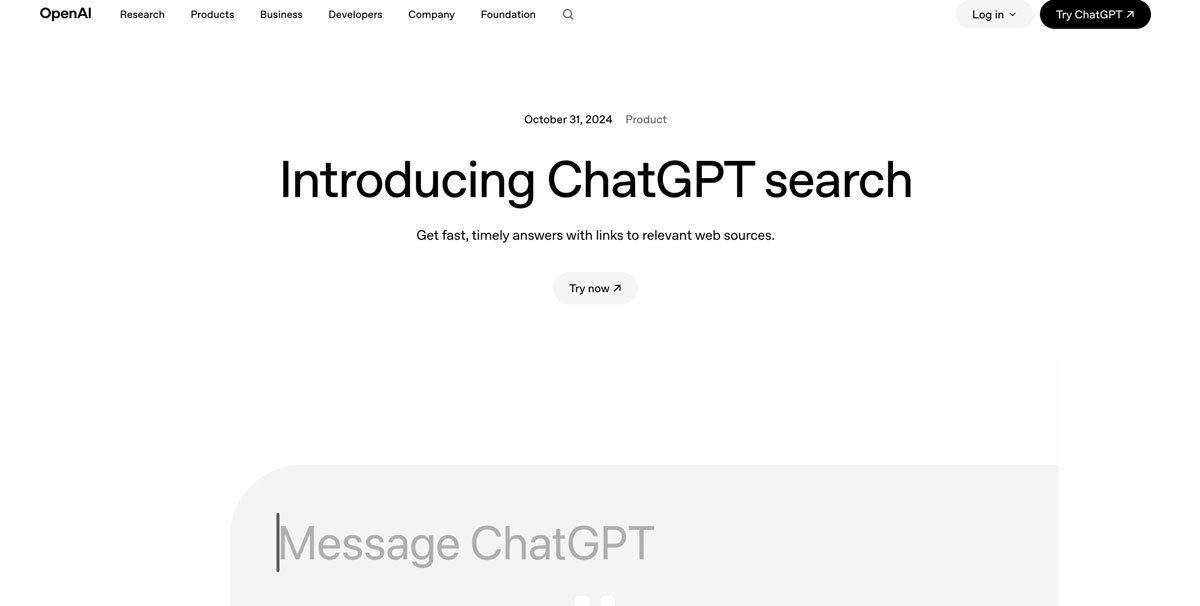
This is the area causing all the conversation. AI search includes Google's AI Overviews (the summarised answers at the top of search results), as well as standalone tools like ChatGPT, Claude, Perplexity, and Gemini, where users ask questions in a conversational way and get a synthesised answer pulled from across the web.
The interesting thing about AI search is that the rules are slightly different. AI tools don't just rank links, they pull bits and pieces from multiple websites to construct an answer. So the goal isn't necessarily to "rank number one", it's to be cited, referenced, and trusted enough that AI tools include your business in their responses.
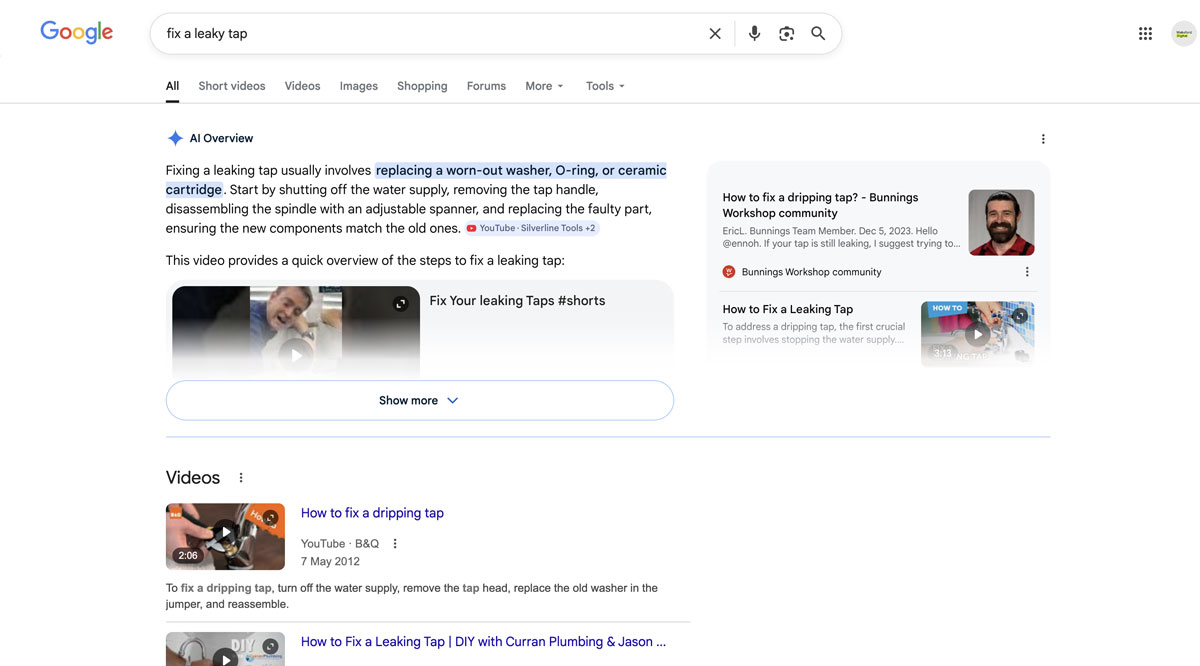
Where AI search really shines is in problem-solving and how-to queries. Someone searching "how do I fix a leaky tap" is getting a beautifully formatted answer with citations, and if your content is one of those citations, that's where new traffic comes from.
Dominic notes: "The key distinction is between general search terms like 'how to fix a leaky tap', where the AI overview is fantastic and you want to be cited in it, versus 'licensed plumber in Hobart', where people are heading straight to the map pack or that older style of search."
"It's an interesting space to watch, particularly for us here at Wakeford Digital HQ."
With the above considered, what's the good news?
Many of the things that help you rank in AI search are the same things that help you rank in traditional organic search.
We've covered the practical side of this in detail in our guide on how to optimise your website and content to rank for AI search and our follow-up on how to check if your website is AI-ready.
If you want a step-by-step playbook, those two posts are the place to start.
Here's our honest take: yes, AI search is worth your attention, but not in the way some agencies will try to sell it to you.
You don't need to drop everything and pivot to an "AI-first" content strategy. You don't need to invest in some new shiny tool that promises to "future-proof" your website. What you do need is to make sure your foundations are solid, because those foundations are what feed all three areas of search.
Dominic continues: "Given the AI side of things is question and answer based, we're certainly focused on the language used on the website. Instead of being very dense, it's short, sharp, and simple."
"This is something we're constantly refining with clients, and it's primarily looked at through the FAQ lens."
A few specific things that genuinely move the needle when considering ranking through AI:
Let's dig into each of these...
If your service pages, blog posts, and FAQs are written like real answers to real customer questions, you're already most of the way there. AI tools are designed to find and cite content that directly answers what someone has typed in. Generic, dense, salesy content does the opposite of that.
A handy exercise: think about the last five questions a customer asked you in person or over the phone. Now check if your website actually answers those questions clearly. If not, that's your first job.
Schema markup is the structured data that tells Google and AI tools exactly what your content is about.
As Dominic points out: "Particularly on the homepage, the LocalBusiness schema type is important."
"And then on blog posts and service pages, we use Webflow's dynamic filtering to assist with that micro-level schema."
It's worth noting that Google officially deprecated FAQ rich results in May 2026, meaning those expandable FAQ dropdowns no longer appear in regular Google search results (Source: Google Search Central). But the FAQPage schema itself still works for AI systems, which read and parse that structured data to find direct answers. So we're still recommending clients build out FAQs with proper schema, just with realistic expectations about how they'll appear in traditional search.
This is a newer one, but worth knowing about. An llm.txt file is essentially a guide you place on your website that tells AI tools how to navigate and reference your content. It's not a game changer on its own, but it's a small addition that helps AI search engines understand your site better.
As Dominic puts it: "It's not necessarily completely changing the way we do things or rebuilding the website. It's just adding elements that help AI and search engines understand a bit better, which is not necessarily a bad thing."
Even though this is more about the map pack than AI search directly, AI tools do read and pull information from your Google Business Profile. A complete, active, regularly updated profile feeds both your local rankings and your AI visibility.
If you're running a small business in Hobart, here's roughly what a balanced, modern search strategy looks like in 2026:
Your website: Built with a focus on user experience, speed, and clear, question-and-answer style content. We build sites on Webflow because it gives us the flexibility to nail the technical foundations and use dynamic schema where it makes sense. If you're curious about what good looks like, have a browse through some of our work on the Wakeford Digital homepage.
Your content: Genuinely helpful blog posts, service pages, and FAQs that answer the questions your real customers ask. Bonus points if it's tied to your local area, because Tasmania-specific content tends to stand out in both Google and AI results.
Your local presence: A complete, optimised Google Business Profile, regular posts and updates, a steady stream of genuine reviews, and consistent business information across the web.
Your SEO: Ongoing work on the technical and content side of your website. We work with businesses across Hobart on this through our SEO Hobart services, and the principles haven't fundamentally changed in 2026, they've just expanded to cover new ground.
If you've got those four pillars in place, you're in good shape across all three areas of search. You're discoverable on Google, visible in the map pack, and increasingly likely to be cited in AI tools when someone in Hobart asks about your industry.
Dominic adds: "It's really about reassurance for our clients that we're doing the things that give a website every chance. With Google, with Bing, with any platform, there's nothing we can do that forces an appearance at number one or guarantees your content gets used in an AI overview. It's all at the whim of Google."
"But there are absolutely things we can be doing, particularly compared to competitors who may be running their own websites, that give your business every chance of actually appearing. And for our ongoing clients, we're tracking that visibility every month so they can see how things are tracking."
Do I need to optimise specifically for ChatGPT or Claude?
Not separately, no. The same things that help you rank well in Google also make your content easier for AI tools to find, parse, and cite. Focus on quality, clarity, and authority across your whole online presence rather than chasing each platform individually.
How do I know if AI tools are sending me traffic?
You can usually see this in your website analytics under "Referral" sources, looking for visits from chatgpt.com, perplexity.ai, claude.ai, gemini.google.com or copilot.microsoft.com. Tools like Humblytics make this even easier to track with a dedicated LLM Referrals view, and we typically include this in our reporting for ongoing SEO clients.
Will AI search replace Google?
Probably not completely, at least not soon. Google still handles around 80% of all search queries, and many people still default to it for navigational and transactional searches. AI search is more likely to coexist with Google than replace it, particularly for informational queries.
Is my Hobart small business too small to bother with this?
Honestly, no. If anything, smaller businesses with strong local foundations are well-positioned to benefit, particularly because AI tools tend to favour clear, specific, location-relevant content over generic, large-scale content. A well-optimised Hobart cafe or trades business can absolutely show up in AI results.
Should I be worried about AI killing my organic traffic?
It's a legitimate concern, particularly for content-driven businesses. Some studies have shown click-through rates dropping when AI Overviews appear on a search result. The flipside is that AI traffic, when it does come through, converts much better. The right response is to focus on authority and helpfulness, not volume for volume's sake.
The shift to AI search isn't a hype cycle that's going to fade away. It's a genuine, structural change in how people find information and businesses online, and it's already underway. But it's also not the apocalypse some headlines would have you believe, and it's certainly not something that requires a complete overhaul of your digital marketing strategy.
For Hobart small businesses, the practical answer is reassuringly simple. Get your foundations right. Focus on being genuinely helpful. Make sure you've got coverage across all three areas of modern search. If you do that, you'll be in a strong position not just for AI search in 2026, but for whatever comes next.
And if it all feels like too much to manage on top of running your business, you don't have to do it alone.
If you're not sure where your website currently stands, or you'd like a hand getting your foundations in shape, we'd love to chat. We offer a free SEO analysis where we'll take a proper look at your site and let you know exactly what's working, what isn't, and where the opportunities are. You can also discuss a project with us directly if you've already got something specific in mind.
Thanks for reading, Dom.