One of the most common questions we get from new clients at Wakeford Digital is some version of: "Our website is looking good now, what should we do next?"
It's a great question and the honest answer is: it depends...
There's a full post coming that unpacks that decision in more detail, but the short version is that it comes down to your goals and the data.
If there's solid search volume for what you offer and the intent is transactional (people actively looking to book or buy) then SEO is often the more valuable, long-term investment.
However if you're already established in search and want to reach a more specific audience quickly, or you need results faster than SEO can deliver, social media advertising starts to make a lot of sense.
There's also a third scenario worth calling out. Some businesses have offers that aren't particularly SEO-driven.
Think a winter tourism deal, a seasonal promotion, a time-limited campaign.
These are situations where you're creating demand rather than capturing it. That's where ads and SEO work together rather than in competition with each other.
Whether you're a tourism operator trying to fill winter bookings, a tradie with a seasonal offer to promote, or a local service business wanting to get in front of new customers in a hurry, social media advertising in Hobart is one of the most targeted and flexible tools available to small businesses right now.
Australians clearly agree.
Social media advertising spend in Australia reached US$3.8 billion in 2024, representing nearly a third of the country's entire digital ad budget, and Facebook alone holds an estimated 80% share of the Australian social media advertising market (Source: We Are Social / Meltwater Digital 2024 Report; Genroe).
There's a reason so many businesses are putting budget into this channel.
This guide is designed to help you understand what the advertising process actually looks like, what each element of an ad does, and what to expect when you're working with us on a campaign.
Let's walk through it...
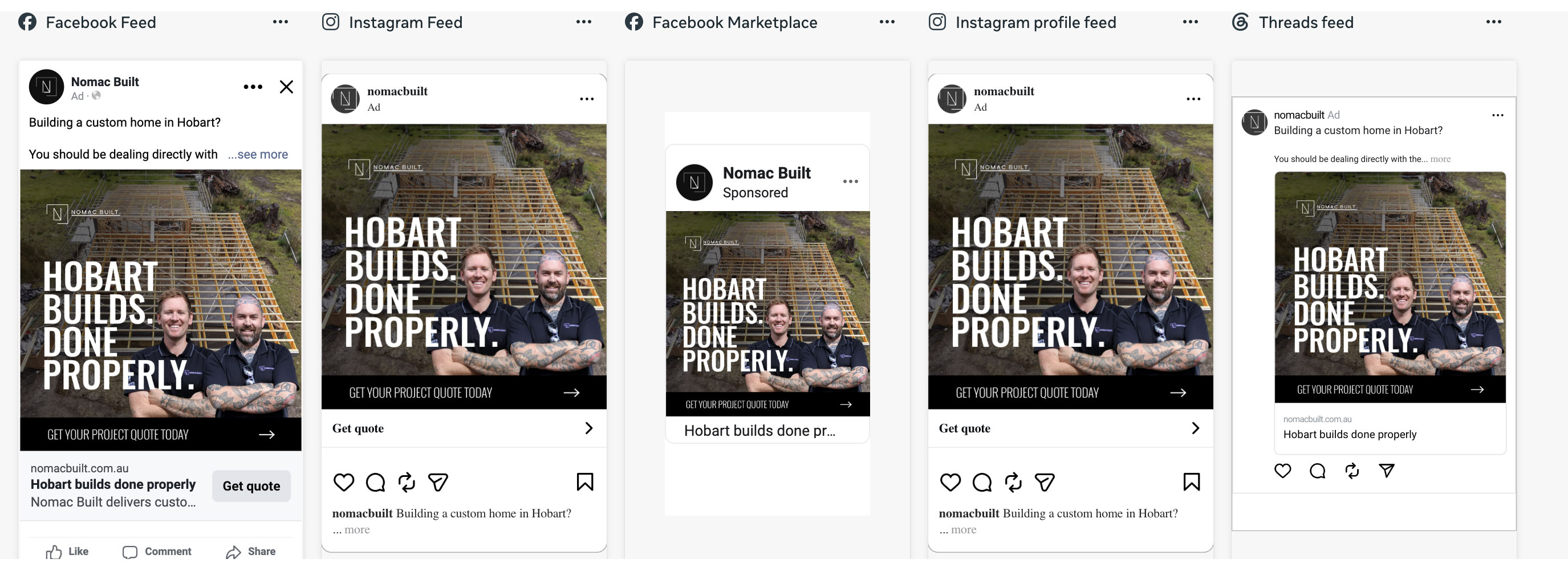
Before we get into strategy and budgets, it helps to understand what you're actually working with. A Meta ad is made up of a few distinct elements, and knowing what each one does makes the whole process far less confusing when we're walking you through a campaign.
Primary Text: The main body of copy that appears above your image or video in the feed. It's where we tell your story, make your offer, or speak directly to a problem your audience has. This is often the most persuasive part of the ad.
Headline: The bold text that appears directly below your image or video. Short, punchy, designed to grab attention. Think of it as the hook that pulls the viewer in.
Description: A smaller line of text below the headline. Not always visible depending on the placement, but useful for a supporting detail or secondary message.
Call to Action (CTA) Button: The clickable button on your ad. Options include Learn More, Book Now, Shop Now, Get Quote, Sign Up, and more. We choose the right CTA based on where your audience is in the buying journey. "Learn More" works well for awareness campaigns. "Book Now" or "Get Quote" signals stronger intent and performs better when targeting people who are closer to a decision.
Dom's Tip: "When we sit down to write the primary text for a client's ad, the first question we ask is: what is the single most specific offer or outcome we can lead with?"
"The temptation is always to go broad and try to capture everyone. But a Hobart plumber advertising a hot water system replacement will consistently outperform one running a generic 'we're your local plumber' message."
"The more specific the offer, the more it resonates."

Social media advertising works best when we're promoting something specific. The more targeted the offer, the more relevant the ad becomes, and relevance is what keeps costs down and results up. Here are the types of campaigns we commonly run for Tasmanian businesses:
One thing worth noting: the first three examples above aren't particularly well-served by SEO. Someone isn't usually searching Google for "Hobart winter accommodation deal".
You're creating demand, not capturing it. That's where Meta advertising and your organic presence work together rather than in competition.
This one comes up a lot, so it's worth being clear about.
When you boost a post, you're taking something you've already published on your Facebook or Instagram page and paying to show it to more people. You can set a rough location and age range, but the options are limited.
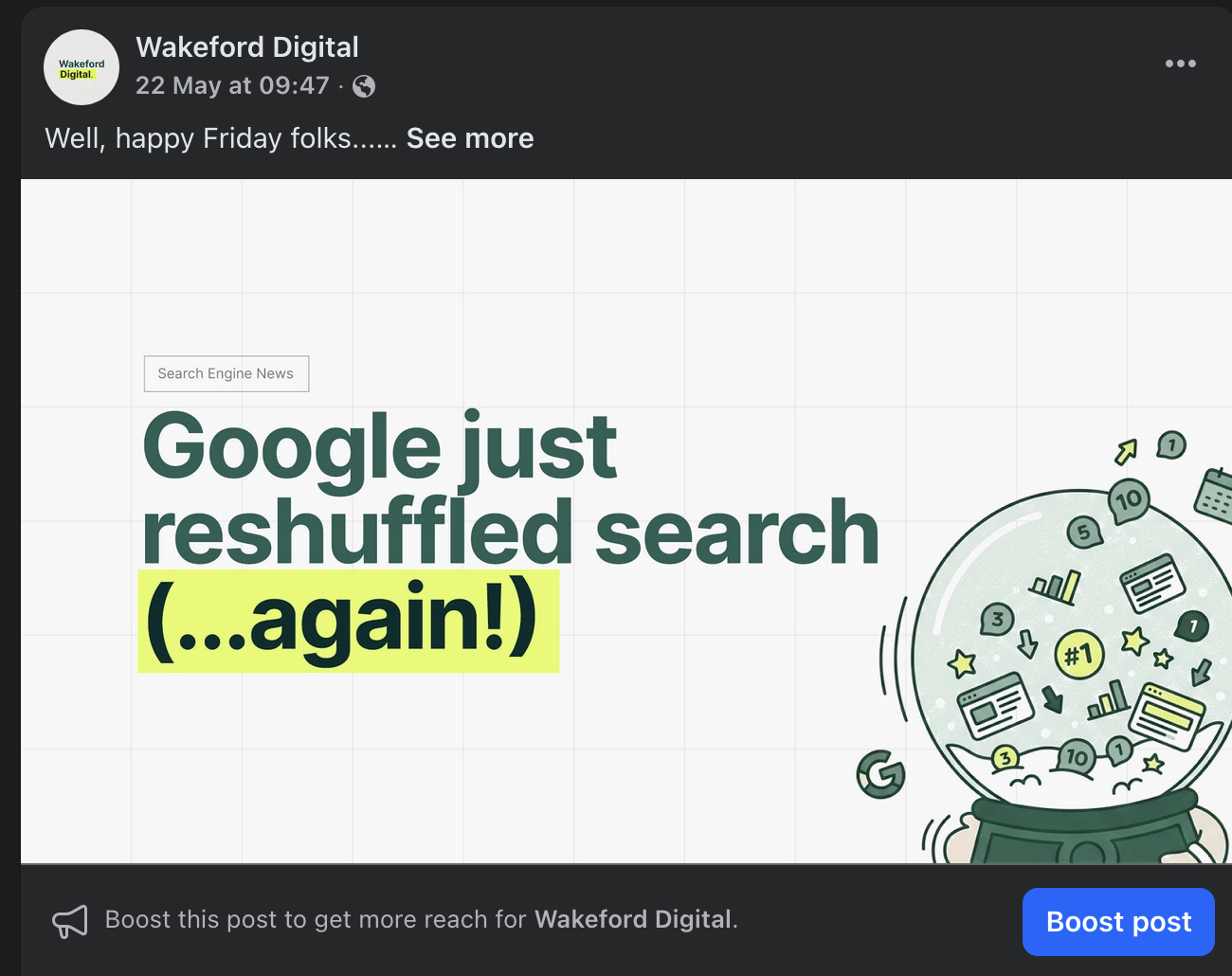
You're also locked into whatever that post was originally about.
If it was a photo of a finished project, that's your ad. You can't change the goal or reshape the message around a specific outcome.
Running a proper Meta ad campaign through Ads Manager is a different thing entirely, here's why...
As Dominic points out: "The boost post button is right there on the screen, so it's the natural starting point for a lot of business owners, and it's not without value for awareness."
"But you're missing the ability to set a real goal and build towards it. Say you're a Hobart builder wanting to reach homeowners thinking about a bathroom renovation. A proper campaign lets you target that specifically."
"A boosted post of your latest project won't give you that control."
Tasmania presents a unique advertising environment. Our audience sizes are smaller than what you'd see in Sydney or Melbourne, and yes, that can feel like a constraint. But there are real advantages that come with it that include:
Highly targeted reach, fast
We can have an ad in front of the right person within hours. Target by suburb, by interest, by behaviour. Want to reach homeowners in Kingston thinking about a renovation? We can get close to that. Want to reach mainland Australians interested in Tasmanian travel? Done. Unlike SEO, you're not waiting months to appear in front of relevant people.
Local creative cuts through
When a local business uses recognisable Tasmanian imagery, a shot of the waterfront, the mountain, a familiar local landmark, people respond immediately. There's an instant recognition that says this is a local business, this is relevant to me. That's something a generic interstate or global ad can't replicate.
Less competition in the auction
Fewer local businesses actively running well-structured Meta campaigns means your ad budget can go further than it would in a more saturated market.
Works hand in hand with your organic presence
A well-run ad campaign reinforces brand recognition. Someone who sees your ad, then later finds you organically in search or on Google Maps, is far more likely to trust you and get in touch. The two channels strengthen each other. For businesses also working on local SEO and reviews, this compounding effect is particularly strong.
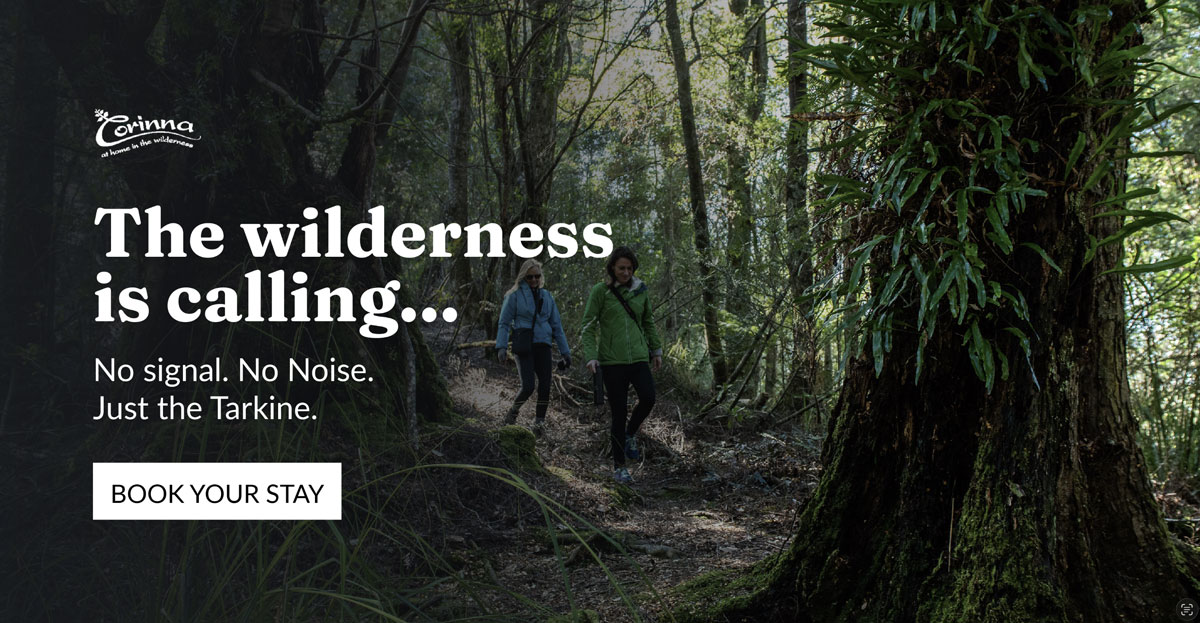
Dom's Tip: "The smaller audience in Tasmania is something we always talk to clients about upfront."
"It does mean you can burn through your audience faster if you're not careful, which is why refreshing your creative matters."
"But it also means that if your ad is locally relevant, if someone in Hobart sees it and immediately knows it's talking to them, you'll cut through far more easily than a generic mainland brand ever could."
If you've been in Ads Manager recently, you've probably noticed Meta pushing something called Advantage+ fairly prominently. Put simply, Advantage+ uses machine learning to automate large parts of a campaign: targeting, placements, and budgeting. The goal is to reduce manual work while improving performance.
The key feature for most small businesses is Advantage+ Audience.
Rather than manually defining the entire target audience, we provide what Meta calls "audience suggestions": age ranges, locations, interests. These are treated as starting hints, not hard limits. The AI then expands beyond those parameters whenever it identifies better-performing users elsewhere on the platform.
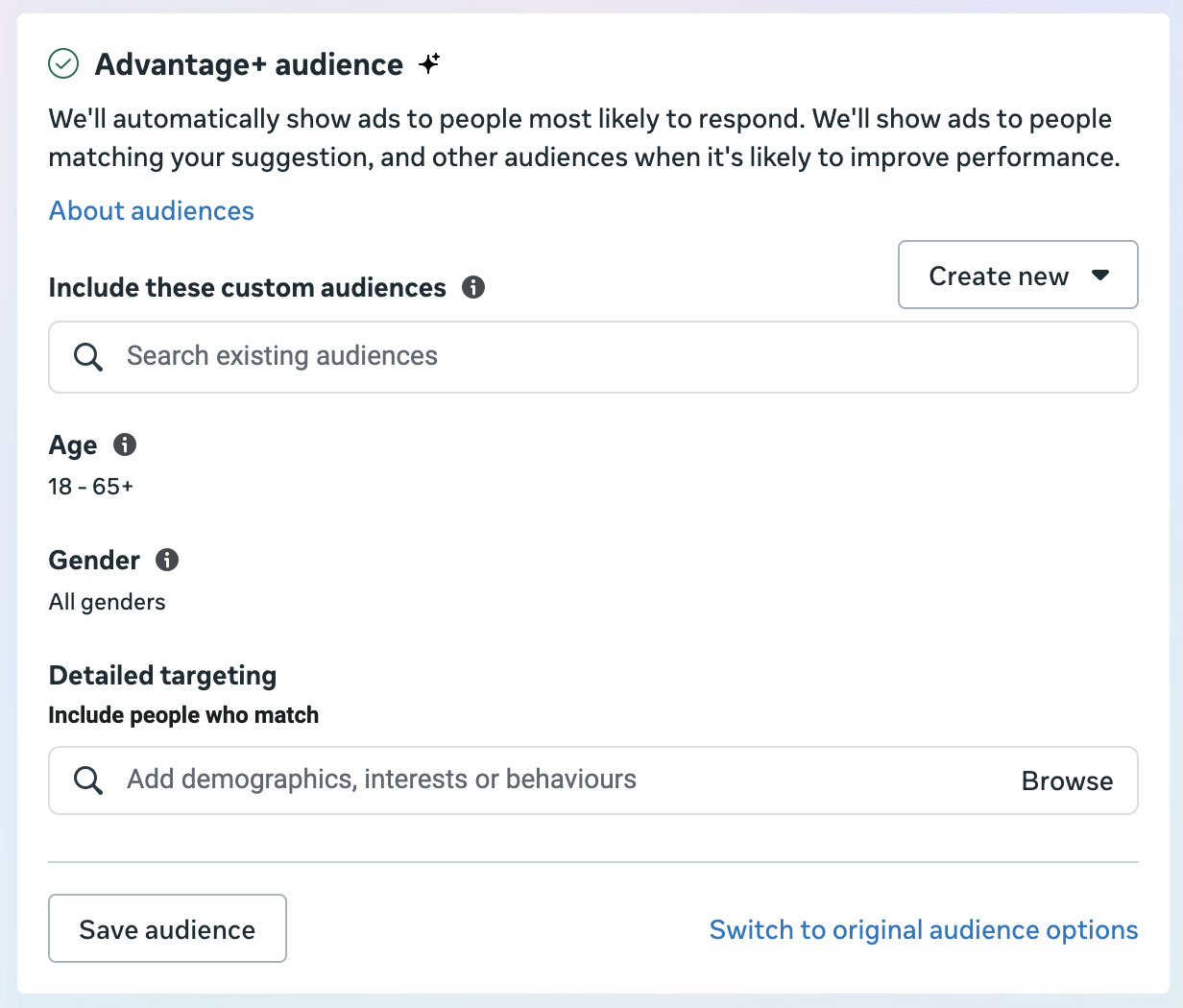
In practice, Meta draws on what it already knows: people following your page, engaging with your content, and visiting your website via the Meta Pixel. Meta has reported a 10% lower cost per qualified lead when Advantage+ features are enabled for lead campaigns, which is meaningful for businesses working with modest budgets.
There's still a learning phase involved.
When we launch a new campaign, the algorithm needs a few days to a week to gather data and optimise delivery.
It's one of the reasons we always set realistic expectations upfront: the first couple of weeks are about gathering data, not judging results. What looks underwhelming on day two can be performing well by day ten.
Before any of this works properly, one thing needs to be in place on your website: the Meta Pixel (also referred to as the Meta Conversion API, or CAPI).
The Pixel is a small piece of code that tracks what visitors do after clicking your ad. Without it, you're flying blind. It also powers retargeting campaigns and feeds data directly into Advantage+, making campaigns improvable over time.
Getting the Pixel correctly installed is something we handle as part of the campaign setup process. If you're on a Webflow site (which is what we build here at Wakeford Digital) it's straightforward to implement.
One of the most effective tactics we use, particularly for clients with smaller ad budgets, is retargeting. Here's the scenario: someone finds your website, looks around, checks your services page, and then closes the tab. Life gets busy. They meant to reach out but didn't.
Retargeting lets us show that person a follow-up ad.
Because they've already visited your site, they're warm. A well-timed retargeting ad can be the nudge that brings them back and converts them into an enquiry. The audience is small but highly qualified, which makes retargeting one of the most cost-effective campaign types we run for Tasmanian businesses.
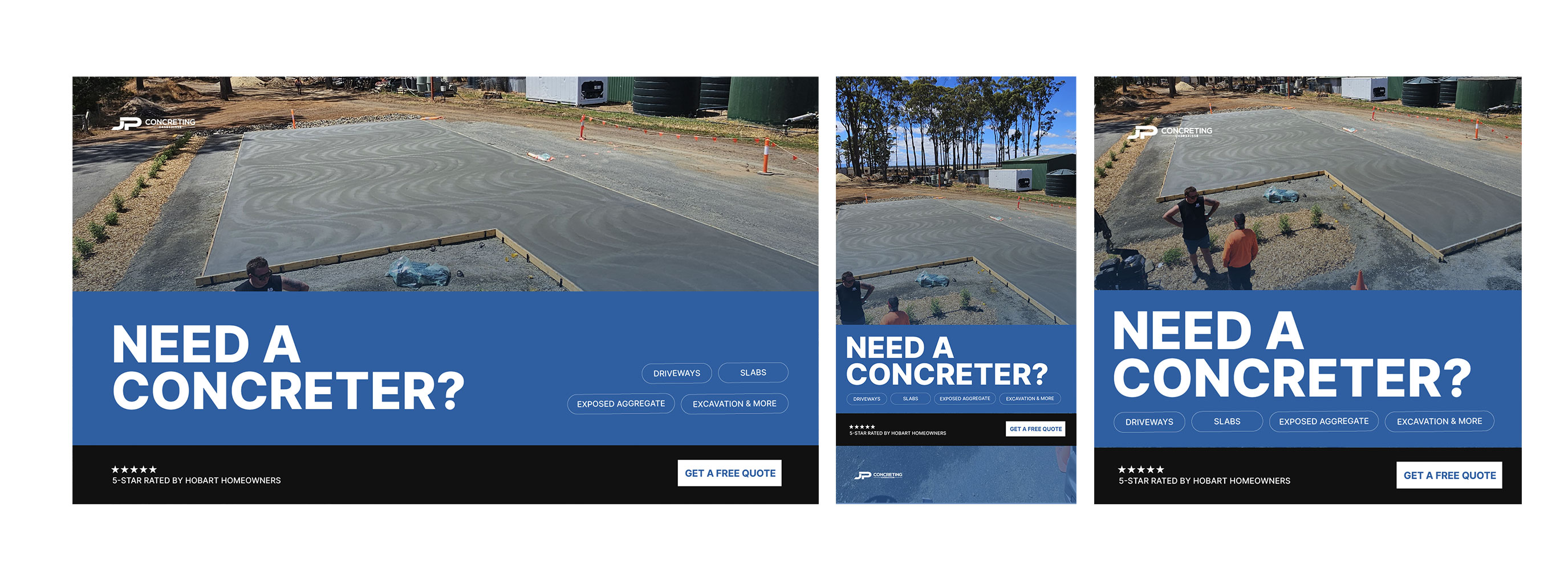
One of the most important things we do in the early stages of a campaign is test multiple creative variations. Rather than running a single ad and hoping for the best, we'll run several versions simultaneously within the same ad set. That might look like:
Over time, the data shows which combinations are generating the most clicks at the lowest cost. That's where we concentrate budget. Video is worth highlighting specifically - it consistently outperforms static images across most ad objectives because people naturally pause for movement in the feed.
Dom's Tip: "The first round of a campaign is often about gathering data as quickly as possible."
"While leads and enquiries are desirable, it's not always realistic to expect forty leads straight away - we're figuring out what resonates with your audience."
"For example, we've done this with Tasmanian fly fishing guide Trout Tales over time, testing a whole range of ads, and we're now at the point where we have specific video ads we can switch on and know they'll engage, and specific campaign types we can turn on when we need to drive bookings. That library of proven creative takes time to build, but it becomes incredibly valuable once it's there."
Check out some of the content created for Trout Tales below...
You've read through the how-it-works side of things, and undoubtedly the main question still sitting in your mind is: what does this actually cost?
Meta's ad system is an auction. You're competing with other advertisers for placement in front of your target audience. A very small budget limits how much data the algorithm can gather and how many people you can reach.
Dom's Tip: "We say $200 a month in actual ad spend is the absolute minimum to get any meaningful data back - but realistically, you'll see better results, and get through the learning phase faster, at $500 to $1,000 a month."
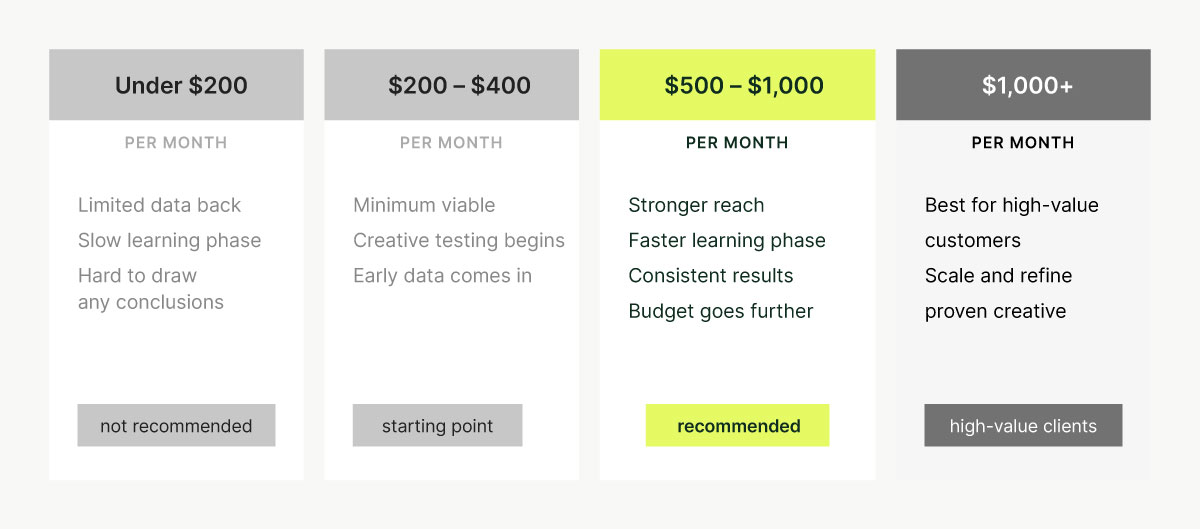
"The other thing to always keep in mind is the value of what you're selling."
"Spend $200 and book one job worth $4,000, that's a fantastic return. Spend $1,000 generating enquiries for an $80 service, the maths looks very different. The budget question can't be separated from what a new customer is actually worth to your business."
On lead campaigns:
Getting leads and bookings is ultimately the goal, but it can be tempting to jump straight to a lead generation campaign from day one. It's worth knowing that even on a solid budget, it's not unusual to invest $100 to $500 before a qualified lead comes through. That's often the learning phase working as it should, and something we factor into how we manage campaigns from the start.
On ongoing management:
An unmanaged campaign can run indefinitely, spending budget without delivering results. Part of what we do is keep a close eye on what's live, pause what's underperforming, and reallocate budget toward what is. This is what separates a well-run campaign from one that quietly drains a budget.
On customer value:
A $200 ad spend that books one renovation project is a very different conversation to $200 generating one casual enquiry. Understanding what a new customer is actually worth to your business shapes every budget decision we make together.
When we take on a social media advertising client in Hobart, we're not setting up a campaign and walking away. The setup is the beginning.
What matters is the ongoing management, creative refresh, and optimisation that keeps things performing over time.
Our work typically forms part of the growth phase for a business: the website foundation is solid, there's some presence in local search, and advertising is the accelerator that drives traffic and builds brand awareness quickly. We work with businesses to get the right foundation in place, and manage things from there.
Depending on where a business is at and what they need, ongoing management may sit with us or transition to an in-house team as the business grows.
If you'd like to understand more about whether social media advertising is the right next step for your business, the best place to start is a conversation. You can discuss a project with us here, or check out our digital marketing packages to see how advertising fits alongside other services.
What's the difference between a boosted post and a Meta ad?
A boosted post takes existing content from your page and pays to show it to more people, with limited targeting and goal options. A Meta ad is built from scratch in Ads Manager, with full control over campaign objective, audience, creative, and budget. Proper ads give access to campaign types, like lead generation and retargeting, that boosting simply doesn't offer.
How long before we see results from social media advertising?
We generally allow at least two to four weeks before drawing strong conclusions from a new campaign. Meta's algorithm goes through a learning phase, typically a few days to a week, before delivery stabilises. After that, patterns in what's working become clear and we can start optimising more aggressively.
What is the Meta Pixel and does my website need it?
Yes. The Pixel tracks what visitors do after clicking your ad and is essential for conversion tracking, retargeting, and feeding data into Advantage+. We handle the installation as part of campaign setup. If you're not sure whether yours is already in place, a free digital analysis can confirm that before we get started.
How do you decide on targeting and campaign type?
We make those decisions based on your goals, your budget, and the data available from your website and existing page. For most businesses starting out, we use Advantage+ audience as the foundation and layer in location and demographic guidance to keep things locally relevant. As campaigns mature and we have more data to work with, we refine the approach.
Social media advertising isn't magic, but it is one of the fastest and most targeted ways to get your Hobart business in front of the right people.
The key is the right offer, locally relevant creative, a realistic budget, and consistent management over time.
When those elements are in place, a well-run Meta campaign becomes a reliable part of a small business growth strategy. Not instead of SEO and local SEO, but working alongside them.
If you'd like to explore whether social media advertising in Hobart is the right fit for your business, we'd love to chat.
Get in touch here, or grab a free website analysis if you'd like to understand the broader picture of your digital presence first.
Thanks for reading!