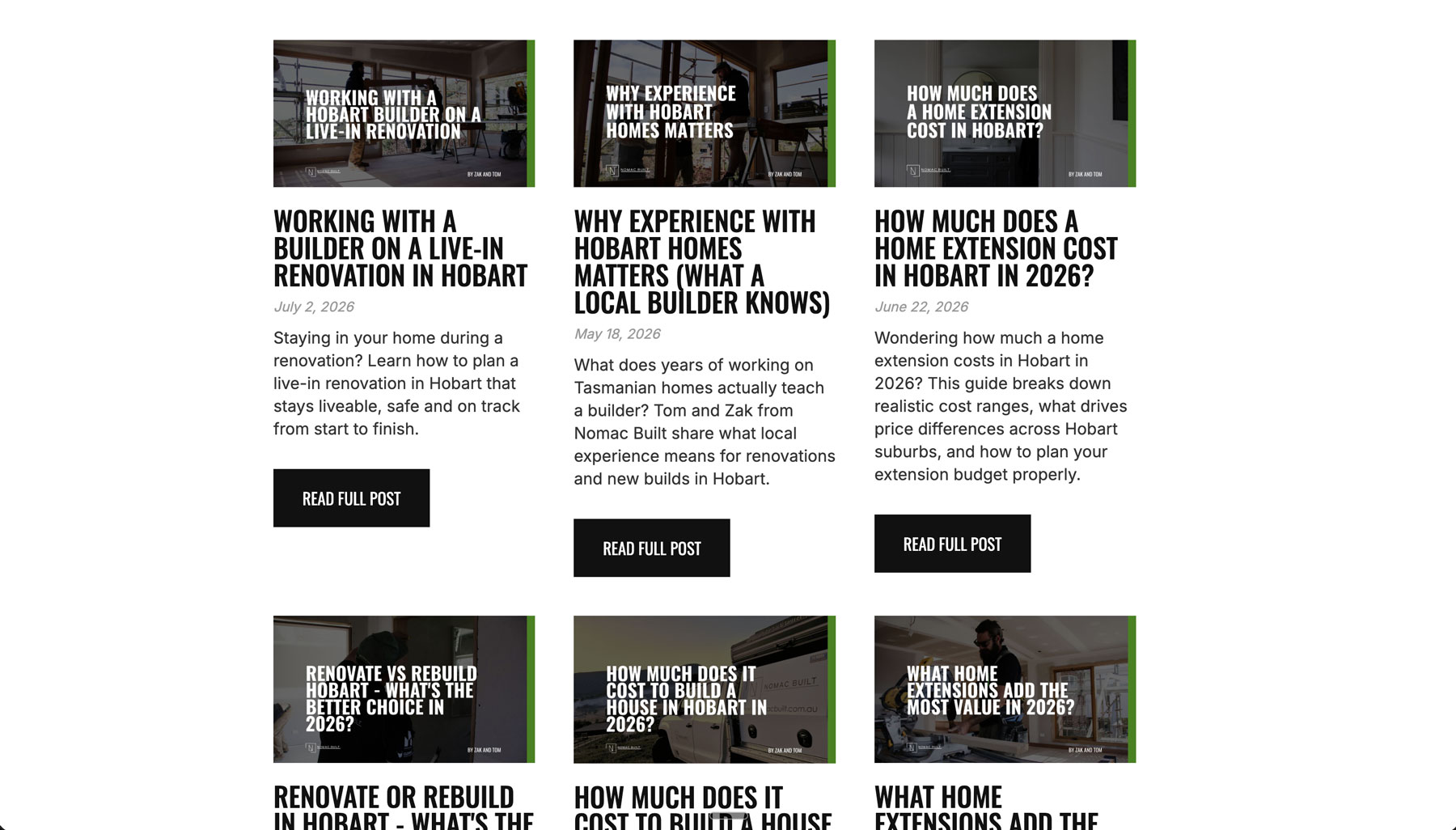
If you run a small business in Hobart, you've probably had this thought at some point: do we really still need a blog?
Maybe you started one a few years back, wrote three posts in a burst of enthusiasm, then never touched it again (yes, you know who you are...)
Perhaps instead you've watched short-form video and social feeds take over and quietly wondered whether blogging is a bit, well, 2015.
It's a fair question. The blogging landscape has genuinely shifted in 2026.
Between the rise of local SEO, the way people search now, and AI writing tools flooding the internet with content, blogging in 2026 looks different to how it did even a couple of years ago.
So let's cut through it. Is blogging still worth your time and money this year?
The short answer is yes, but with some important context that most “10 reasons you should blog” articles conveniently skip over.
It also depends heavily on what else is going on with your site. A blog sitting on top of dated web design in Hobart with no real SEO foundation is a bit like putting a spoiler on a car with no engine.
Before we get into the how, it's worth being upfront about where we stand, because this isn't a blanket “everyone should blog” pitch.
The truth is that whether a blog actually works comes down to more than just writing posts.
Dominic, owner of Hobart web design business Wakeford Digital shares:“We feel a successful blog really comes down to systems and strategy."
"Context matters a lot too - if a business is just starting out, we're not going to have them writing blogs at the expense of getting their core service pages sorted first, because that's the foundation everything else sits on. And blogging does take time and effort, particularly if you're managing it yourself."
"That said, there's absolutely real value in it. It's just something you've got to be able to commit to. There's no point doing three posts and then leaving it for twelve months and expecting much to happen.”
Let's start with the numbers, because they're more encouraging than the “blogging is dead” crowd would have you believe.
Businesses that blog see around 55% more website visitors than those that don't (Source: HubSpot). For smaller businesses specifically, blogging has been linked to 126% more lead growth compared to businesses that skip it (Source: DemandSage). And marketers who genuinely prioritise blogging are 13 times more likely to see a positive return on investment (Source: HubSpot).
Those are strong figures. But here's the part that matters: they apply to businesses that blog well, not businesses that publish for the sake of publishing.
There's a real difference between the two. Informed blogging uses keyword and search data to shape what you write about, so each post is actually targeting something people are searching for. Writing for the sake of writing, on the other hand, tends to produce posts that feel nice but never get found.
Dominic notes: “There's a big difference between blogging just to have content and what we'd call informed blogging, where you're actually using keyword and search data to shape what you write about."
"If you're writing to a plan, every post has a job to do, whether that's answering a common question or targeting a search term people are actually typing in."
"The other half of it is just having a system, a content calendar mapped out in advance, so it's not a mad scramble at the end of each month trying to think of something to write. That's usually where good intentions fall over, when there's no plan behind it.”
Here's where a lot of business owners misjudge blogging. They picture it as a single lever: write a post, hope it ranks, wait.
In reality, one good blog post can quietly power several of your other channels at once:
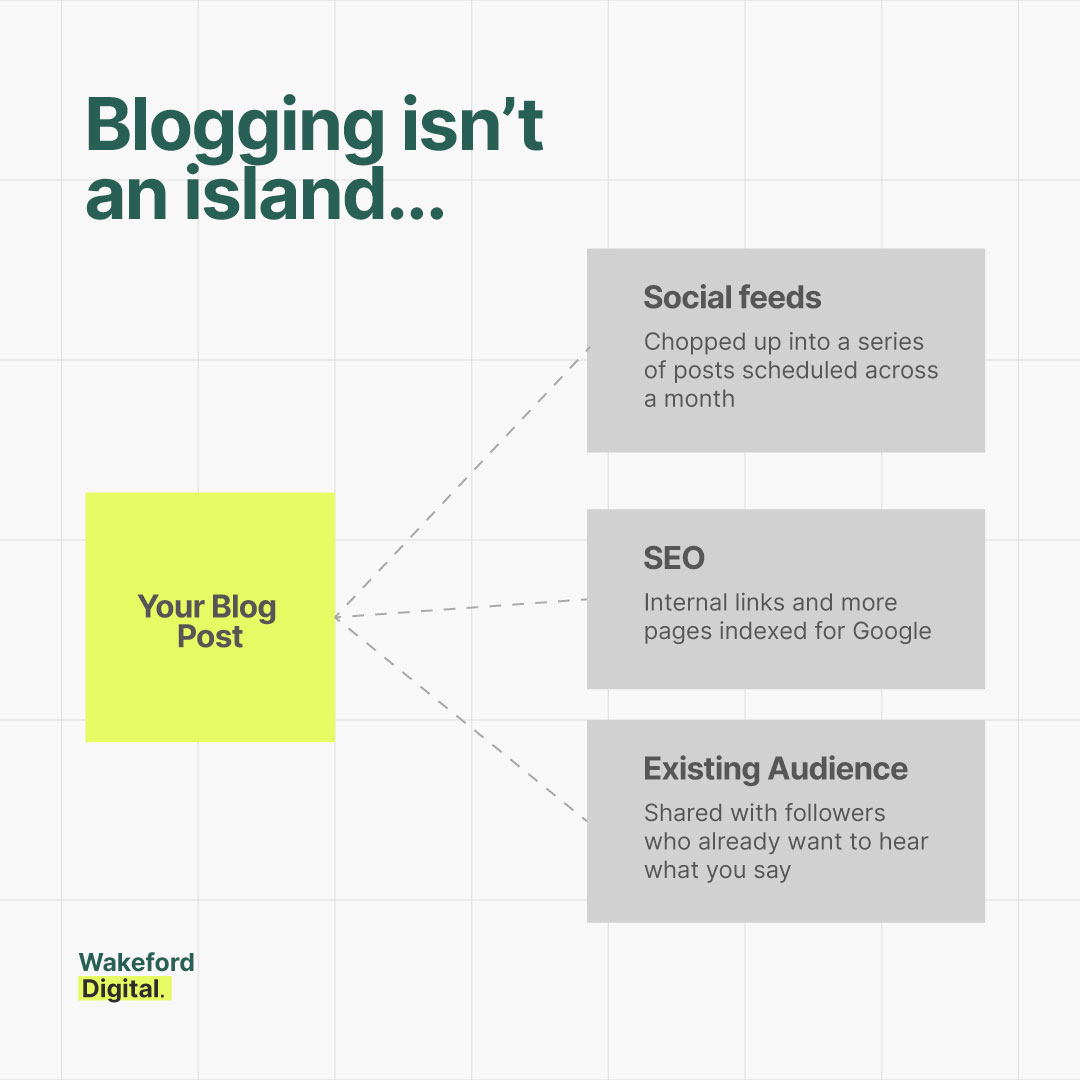
Some of the often overlooked benefits of blogging for a local business can include:
The most overlooked example is social media. If you've ever sat there on a Sunday night wondering what on earth to post on Instagram or Facebook this week, blogging solves that.
A single, well-written post can be chopped up into three, five, or even ten social posts and scheduled out across a couple of months. It takes a bit more effort up front than dashing off one caption, but you get far more mileage from it.
As Dominic points out:
“One benefit people really overlook is that a single blog post can be chopped up into ten social posts and scheduled out over a couple of months. So instead of staring at a blank screen every week wondering what on earth to put on socials, you've already got the content sorted."
"It takes a bit more effort to write the post in the first place, sure, but then you're getting ten pieces of content out of one, rather than starting from scratch every single time."
"For a local business that's often struggling to know what to share, that's a genuine relief.”
Next is the SEO side...
Every time you publish a helpful post and link it back to relevant service pages on your site, you're telling search engines like Google that those pages have relevance and authority.
Over time, that internal linking builds a kind of architecture across your website.
It's part of why sites with active blogs tend to have far more indexed pages, one widely cited figure puts it at around 434% more (Source: OptinMonster), giving you many more doorways for people to find you.
You can also share each post with the audience you already have. Most businesses, even small ones, have a following of some sort, whether that's family, friends, past customers, or a wider community who've already liked and followed.
Publishing and then not sharing your content is a genuinely common mistake. The blog post you sweated over shouldn't just sit there hoping to rank; it should go out to the people already happy to hear from you.
If your social presence is where you're struggling most, our social media advertising services can help you turn that blog content into a proper campaign.
See an example below of how graphically displaying and sharing a blog post can help increase its reach to an existing audience, as demonstrated by Corinna Wilderness Village.
Here's a trap we see constantly: A business writes a short, light article, thinks “great, that's helpful,” and publishes it.
The problem is that Google isn't comparing your post to nothing - it's comparing it to whatever your competitor has published on the same topic.
Recent data backs this up: longer, more comprehensive posts (often 2,000 words or more) tend to correlate with stronger results, provided the length comes from genuine value rather than padding (Source: Orbit Media). The goal isn't word count for its own sake, it's covering a topic properly.
Dominic highlights the importance of this balance:
“You might write a nice light article and think that's great, job done, but Google's sitting there comparing it to a competitor who's gone into real depth, added a checklist, a download, maybe even a video."
"We know that search engines like Google want to return the best result for whatever someone's searched, so more often than not, the more thorough one is going to win out."
"But you can't just write for the algorithm either. It's about finding the balance between writing something a real person actually wants to read, and making sure it ticks the boxes for search at the same time.”
You can't talk about blogging in 2026 without talking about AI. And to be clear, it's a genuinely useful tool. Used well, it speeds up brainstorming, drafting, and repurposing enormously.
But it's also where a lot of businesses come unstuck.
The data is telling here: content that's purely AI-generated tends to underperform in search, while AI-assisted content (human-edited, human-guided drafts) achieves roughly 93% of the ranking performance of fully human-written content, at 43% of the cost (Source: DigitalApplied, 2026). The difference is entirely in how it's used.
Dominic shares:
“AI is a brilliant and useful tool, but it's also where a lot of businesses trip up. It's really easy to fall into the trap of using it to just churn out generic blog posts, and you can usually tell when something's been written that way."
Dom's advice: use AI as a tool inside a proper process, with real human judgement guiding the topics and the actual insight.
"AI great for getting a draft moving or bouncing ideas around," he continues, "but you can't just hand the whole thing over to a machine and hope for the best. The businesses that get real value from it are the ones still doing the thinking themselves.”
So the takeaway isn't “avoid AI” or “let AI do it all"; It's somewhere in the middle.
The businesses getting value from it treat it as an assistant that speeds up the parts it's good at, while a human still steers the strategy, adds the genuine expertise, and makes sure it actually sounds like you. The ones getting burned treat it as a replacement and wonder why their traffic never moves.
That distinction, more than any tool or trend, is what separates blogging that works in 2026 from blogging that just adds to the noise.
This is the question every small business owner really wants answered: how long until it actually works?
The honest answer is that it's contextual. It depends on factors including:
It's rarely a neat, linear timeline.
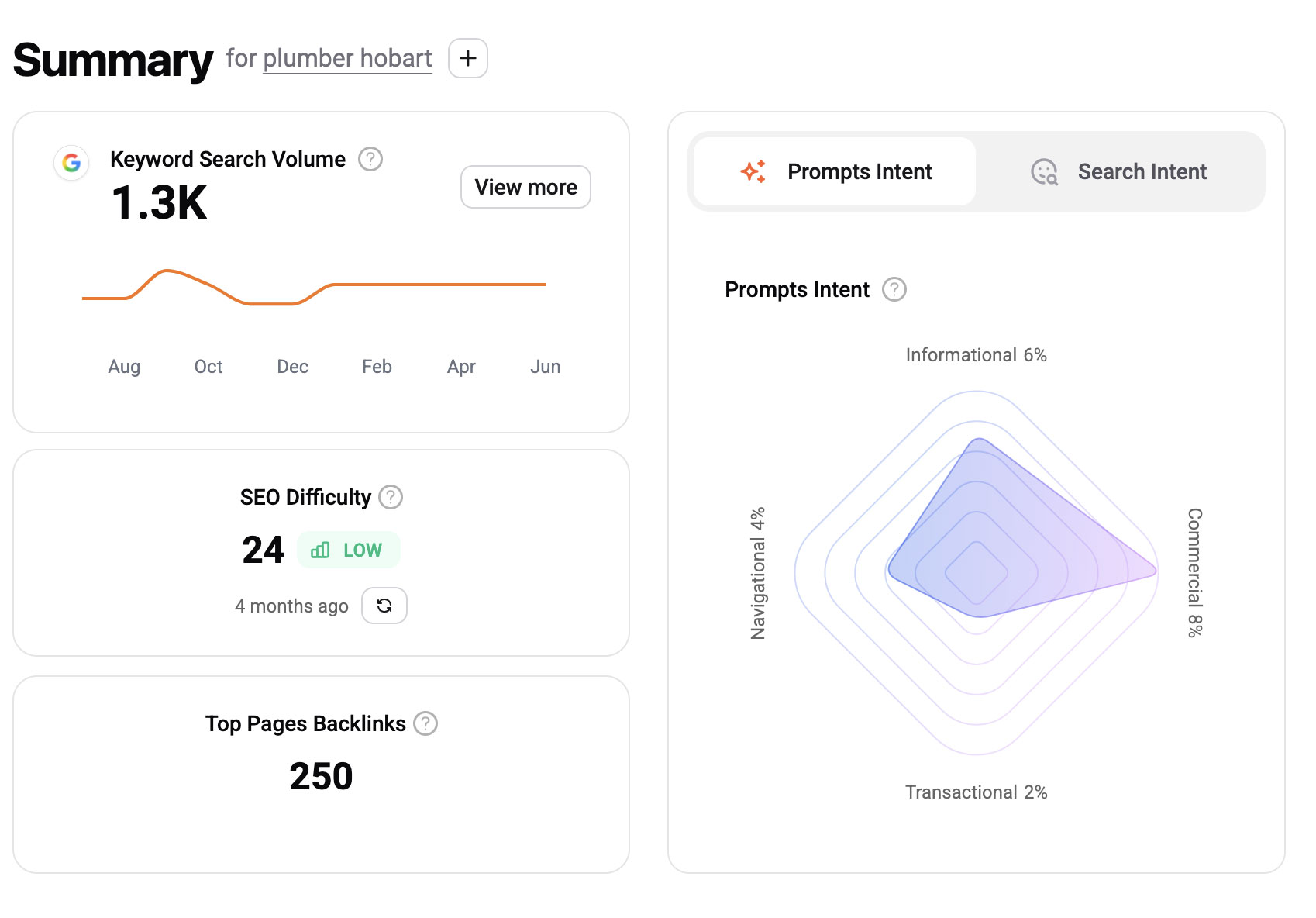
What's more useful is understanding how blogging pays off. It's not usually the thing that lands you the single most competitive keyword, that's a job for your homepage and core service pages. Blogging tends to help you rank for the longer-tail, less competitive terms, while quietly painting a broader picture of authority across your whole site.
Here's a rough illustration of how that compounds as you add more quality content. These numbers are illustrative only, just to show the shape of it, not a promise:
You can see the idea though: each service page opens up a new cluster of keywords, and the blog then stacks on top, mopping up all the longer-tail searches the main pages were never going to target on their own.
Dominic explains, “Blogging isn't the only strategy, and honestly it's rarely the fastest. Where it earns its keep is painting a picture of authority over time, and helping you rank for the longer-tail, less competitive terms while your main service pages do the heavier lifting on the big keywords."
"As we mentioned it's contextual too, where a lot depends on your market and how established the competition already is"
"Here at Wakeford Digital, our systems tend to run over about three months, and if the blogging's done well and it's backed up by the right website architecture underneath it, that's usually a realistic point to start seeing the dust settle, the site properly indexed, and the results begin to come through.”
So if you're expecting leads to pour in a fortnight after your first post, adjust the expectation.
Think in terms of a few months, and think of the blog as one part of a bigger SEO strategy for your Hobart business rather than a magic switch.
Here's something you won't hear from most agencies who'd happily sell you a blogging package regardless: sometimes, blogging shouldn't be your first move.
It's less about a particular type of business and more about where you are on your journey. A few situations where we'd usually say “not yet”:
Blogging leans on people actively searching, which is powerful but slower. So it's about being honest about whether that's the right lever to pull right now.
As Dominic suggests:
“It's less about a particular type of business and more about where you are on your journey. We've had clients come through a rebrand with an old, outdated blog sitting there, where blogging would genuinely help them down the track, but it's just not the priority right at that moment. There are usually more important foundations to sort first."
"And if you're in retail or ecommerce, honestly, something like social ads or video might get your products in front of people a fair bit quicker than waiting on search. It all comes back to putting your budget where it's going to work hardest for you right now.”
The point is that good strategy means putting your budget where it'll work hardest for your specific situation, not blogging just because everyone says you should.
Is blogging still worth it in 2026?
Yes, for most businesses. Blogging still drives traffic, builds authority, and feeds your social and email channels. The catch is that it needs to be done consistently and informed by real search data, not published sporadically and left to gather dust.
How often should a small business blog?
Consistency matters more than volume. A steady rhythm you can actually maintain, whether that's fortnightly or monthly, beats a burst of posts followed by a year of silence. A planned content calendar makes this far more manageable.
Can I just use AI to write my blog posts?
You can use AI to help, but not to do the whole job. Purely AI-generated content tends to underperform in search, while AI-assisted, human-guided content performs well. Treat it as a tool, not a replacement.
How long before blogging shows results?
Around three months is a realistic starting point when it's done well and supported by solid web design and SEO foundations, though it varies with your market and competition. Blogging is a long-term play, not an overnight fix.
Should I focus on social media instead of blogging?
It depends on your business. For some, especially retail and ecommerce, social ads or video may deliver faster returns. For many others, the smartest move is combining the two, using blog content as the fuel for your social posts.
Blogging in 2026 isn't dead, but it's not a set-and-forget tick-box either.
Done properly, it drives traffic, builds authority, feeds your social feeds, and strengthens the whole architecture of your website. Done lazily, or handed entirely to an AI, it just adds to the noise.
The real question isn't “should I blog?” so much as “is blogging the right priority for my business, right now, and do I have the systems to do it well?”
For a lot of Tasmanian small businesses, the answer is a confident yes. For others, the effort might be better spent getting the web design and SEO foundations right first.
If you're not sure which camp you're in, that's exactly the kind of thing we're happy to talk through. We can help you work out where blogging fits alongside your service pages, local SEO and social, and put the systems in place to make it genuinely worthwhile.
Feel free to discuss a project with us or take a look at our digital marketing packages.
Thanks for reading!